
Chapter Text
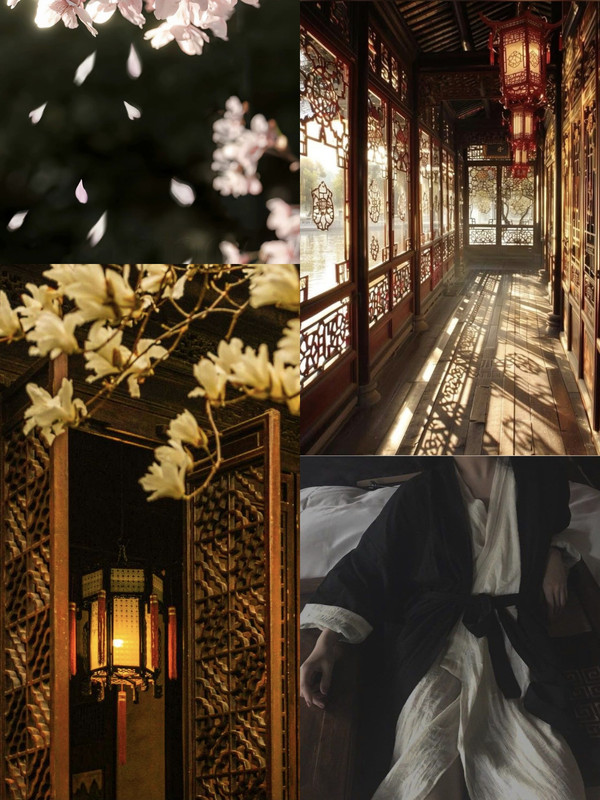
The ninth day of the twelfth month fell during the coldest week the capital had seen in eleven years, and it was on that night, with frost cracking the lake ice in the western gardens, that Consort Lin Wan gave the Emperor his third child.
The labor had gone on since midday. By the time the physicians allowed anyone into the birthing hall, the candles had burned down twice over and the Emperor had been pacing between the doorway and the window, refusing the tea his attendants kept pressing on him. Tang Yuanjing was not a man given to visible worry. He had led armies before he took the throne, had watched men die in far worse ways than this, and had trained himself since youth to let nothing show on his face that he did not choose to show. But an omega's labor was its own kind of battlefield regardless of how many times a household had survived it before, and the most important , this was his very own omega who was the very life of him.
Inside, Lin Wan was doing what he did best in difficult circumstances, which was refuse to be difficult about them. Between contractions he complained , that the head physician's hands were cold, that the incense was too heavy, that if one more person told him to breathe he would have them reassigned to the border garrisons. The physicians had long since stopped taking him seriously when he threatened their careers. His maids had not.
"Nearly there, Your Majesty ," the head physician said, not for the first time.
"You said that a candle-mark ago."
"It was true a candle-mark ago as well."
Lin Wan laughed, which turned into a groan, which turned into the particular silence that meant something was actually happening, and forty minutes later the hall filled with a thin, furious cry.
"A prince," the physician said, and then, checking, checking again, with the kind of hesitation that made every attendant in the room go very still, "an omega, Your Majesty — an omega prince."
There was a pause before anyone moved, the length of a held breath, because in four generations of the House of Tang there had never been an omega born to an Emperor's line. In the court, Omegas , whether daughters, cousins, or consorts through marriage, were a common and accepted presence.But a prince who was an omega, a son of the Emperor's own body who would carry that scent and that biology into every negotiation of his life , no one in the room had precedent for what that meant, and so no one in the room said anything at all, until Lin Wan, exhausted, sweat-soaked, utterly unbothered by the weight everyone else was placing on the moment, said, "Well? Is he well-formed or not? I did not do all that work to be kept in suspense."
They brought the child to him, still creased and outraged at the indignity of having been born at all. Lin Wan, who had complained without pause for the better part of an hour, went abruptly and completely silent. Something in his chest opened in a way he had no name for not pain exactly, though it sat in the same place pain usually did. He touched one small clenched fist with the tip of his finger and felt it grip back, blind and reflexive, and something about that small unthinking grip undid him more than the labor had. He had a full head of black hair already, this furious little person, and when Lin Wan looked at him he stopped complaining about anything at all.
"Phuwin," he said, trying the name out, though it had not officially been chosen yet, though tradition said the Emperor ought to be the one to name him. "You look like Phuwin to me." He said that with a smile that reached his eyes.
Later, when Yuanjing was finally let into the room and told what his physicians had told him with careful, uncertain phrasing “an omega, Your Majesty, we wished you to know before the announcement is made” he did not react the way the physicians seemed braced for him to react. He crossed the room, took the child from Lin Wan's arms with the particular carefulness of a large man handling something he is afraid of breaking, and looked at his son's face for a long moment.
"Phuwin," Lin Wan said again, watching him. "I've already decided. You may argue if you like."
"I'm not going to argue." The Emperor's voice had gone rough in a way it rarely did outside this room. " I can't even win in a game of chess with you how do I even seek that position when naming our precious child whom you gave birth with your own body. Not in my wildest dream my majesty ” he said that with such fondness that if some outsider saw him now they will never guess it was the same emperor , who ruled with an iron fist. His hand reached out, gently caressing the soft fabric of his half fallen gown, a gesture of profound affection that underscored the depth of his devotion. "You, my love, is the world to me . This decision, above all others, belongs to you. It is a reflection of the love and joy you have brought into my life, and into the life of this empire." His gaze, usually sharp and authoritative, softened as he looked at him, a silent plea for him to embrace this moment, this shared creation.
Lin Wan, utterly overwhelmed by the love the man in front of him showed, agreed easily, smiling.
He was exhausted and gestured to his mate to sit beside him , he caressed the small fist reaching up , " Phuwin. He'll be sharper than the both of us, mark my words."
The Emperor did not answer that. He was looking at the baby's small furious face, and something in his chest had gone tight and strange, an unfamiliar feeling for a man who rarely let anything show so plainly, even now, even with two children already grown sturdy and loud through the palace halls and a third who had, against every quiet fear he had not admitted to anyone, arrived safely. His hands were not quite steady where he held him, and no one in the room was foolish enough to remark on it. He had spent the whole of that long night rehearsing, without meaning to, the words he might have had to say if the physicians had come out with different news, and now that no such words were needed he found he did not know what to do with all the fear he had nowhere left to put, so he simply sat there and let his son's small weight absorb it instead. He did not say any of this aloud. He simply held his son a while longer than was strictly necessary, until the physicians began exchanging glances about needing to attend to the consort, and only then did he hand the child back.
The announcement went out to the court the following morning: the Emperor had a third child, a prince, born healthy on the ninth night of the twelfth month. The matter of the child's secondary gender was handled with more delicacy, it was announced separately, a day later, after the Chancellor and the Ministry of Rites had been given time to compose language that would not sound like uncertainty. “The Emperor's court celebrates a rare and auspicious birth,” the proclamation read, which was true, if one did not examine too closely how many people in the Ministry had spent that day in genuinely anxious debate about precedent, inheritance law, and what in the world they were going to do about a prince who could not, by any existing statute, be named Crown Prince even if he had been born first instead of third.
He had not been born first. That, at least, uncomplicated things considerably. The Crown Princess Tang Mei was eleven years old already, sharp-eyed and steady even then, and no one seriously doubted that the succession would run through her. The new prince would grow up in the pleasant, complicated position of being much loved and mostly unburdened by the throne though no one in that cold month knew yet how much trouble, and how much light, he would bring to the palace regardless.
The Lertratkosum family arrived for the hundred-day celebration in early spring, when the lake had thawed and the plum blossoms had come and gone and the whole garden smelled faintly of the peonies Lin Wan kept in every room he occupied. General Lertratkosum Boyuan had served under Yuanjing for two decades, first as a junior officer and then, after the border campaigns that had secured the northern passes, as one of the most trusted commanders in the empire. He came to the capital perhaps twice a year, and always brought his family: his omega spouse Mu Chenxi, quiet and watchful where Boyuan was blunt and loud, and their son, a serious three-year-old named Naravit who had inherited his father's height for his age and his other father's habit of saying very little until he had decided a thing was worth saying.
The celebration was a modest affair by palace standards , modest meaning only forty guests instead of four hundred, held in the smaller reception hall rather than the grand one, because Lin Wan had specifically requested it be kept intimate. "He is a hundred days old," he'd said to the Emperor, with the particular flatness he used when he intended to win an argument, "not conducting a state visit. I won't have him screamed at by two hundred strangers before he can hold up his own head."
So it was a small enough gathering that when little Naravit wandered away from his parents during the tea service and made his way, with great solemnity, toward the cushioned dais where the infant prince lay sleeping, several people noticed, and none of them stopped him.
He stood at the edge of the dais for a long moment, studying the baby with the intense, unblinking focus small children sometimes bring to things adults have stopped finding remarkable. Prince Phuwin , hundred days old was round-faced, dark-haired, entirely unaware of being observed,slept on.
"He's very small," Naravit announced to no one in particular, which drew a soft laugh from the nearby attendants.
"He's a hundred days old, young master," one of them said. "You were smaller than that once."
Naravit considered this with visible skepticism. "I don't remember."
"No one remembers being that small."
He continued watching the baby for a while longer, and when Phuwin stirred and made a small unhappy sound in his sleep, Naravit entirely without being asked, entirely on his own initiative reached out and patted the blanket near the baby's shoulder, the exact gesture he'd clearly seen adults make, until the baby settled again. Satisfied, he nodded once, as if a job had been completed to his standards, and returned to his parents' side.
"What were you doing?" his father asked, amused.
"Making sure he was all right."
"He's a baby, Naravit. Babies cry. That's what they're for."
"He shouldn't cry," Naravit said frowning. He looked like someone had personally offended him. Chenxi asked “ why son ?” Naravit as if it was a universal fact said without any hesitation “ he's so small and adorable why would he cry ? He shouldn't hurt ”
The adults who were present nearby visibly melted at his conviction. A child merely three years old had taken upon a responsibility even adults are afraid to take.
Soon after as naravit found himself a tray of honey cakes and distracted himself from the adults who were still half smiling and half cooing at him.
The adults laughed about it for the rest of the afternoon , the serious little Lertratkosum boy standing guard over the Emperor's newest son, as though he'd appointed himself to some post no one had offered him. Boyuan told the story twice more before the evening was through, each time with more embellishment, until Naravit, deeply unimpressed with being made the subject of adult amusement, informed his father that he would not be attending any more parties if this was how he was going to be treated.
"You'll attend exactly as many parties as I tell you to," Boyuan said, not unkindly, and ruffled his son's hair, which Naravit also did not appreciate.
It was later that evening, after most of the guests had gone and the hall had thinned to family and the closest of the Emperor's circle, that Lin Wan and Mu Chenxi found themselves sitting together near the garden doors, each nursing a cup of tea gone lukewarm, watching their respective families from a small distance. Boyuan and Yuanjing had fallen into the kind of loud, comfortable argument old soldiers have about a border skirmish neither of them had thought about in years. Naravit had fallen asleep against a cushion, worn out from the day. Somewhere further off, the Crown Princess was showing her new baby brother off to a cluster of admiring cousins with the fierce proprietary pride of an eleven-year-old who has decided something is hers to protect.
"Your boy is sweet," Lin Wan said. "Watching over Phuwin like that."
"He's serious for his age. Boyuan worries it's my fault I was the same as a child, apparently. Too solemn." Chenxi glanced toward his sleeping son. "He'll grow into it. Or out of it. I never know what to do with him."
"Phuwin will be nothing but trouble, I expect. He already fusses when things aren't to his liking, and he's not even old enough to know what liking is."
"Takes after his father, then." Chenxi said taking a sip of his tea .
"I have no idea what you mean." Lin wan denied the very subtle allegations however he was smiling fondly.
They sat for a while without speaking, which was comfortable between them in the particular way it can be between two people who share a category of life , omega consorts to powerful alpha men, both of them aware in ways their husbands would never fully have to be of what it meant to raise children who would be watched, judged, weighed against expectations before they could walk. Chenxi had said once, in an earlier conversation, that he sometimes worried what it would mean for Naravit to grow up an alpha in a military family, expected to be hard when he had a soft heart underneath it. Lin Wan had said now, watching his own son who was looking amused with his elder sister, that he worried what it would mean for Phuwin to grow up an omega prince at all, under the pressure of scrutiny from the entire clan.
"Do you ever think about it," lin wan said eventually, watching his son, "what kind of person he'll marry. Whether they'll be good to him."
"Constantly. I have opinions already and he's three years old." Chenxi said eagerly.
"I don't have opinions yet. I suppose I will." Lin wan was quite a moment, as he wondered in his mind the dry humor had gone out of his voice entirely. "I only want someone who chooses him. Not because of what marrying into your line would get their family, not because he's convenient just someone who actually wants him, the way you'd want a person and not a position. That's all I've wanted for Mei and Skaí too, and I don't know how a parent is ever supposed to make sure of that. I don't think you can."
"No," Chenxi agreed, softer than he usually allowed himself to be. "You can't. You just have to hope you raised them well enough to know the difference themselves, when the time comes."
Lin Wan looked over at Phuwin again, small and now sleeping after being exhausted by his sister's endless flaunting and entirely unaware of the conversation being had about his future. something soft and half-joking rose up in lin wan, the kind of thing said between friends late in an evening with wine still warm in the blood and a whole unbearable tenderness underneath it that neither of them would have named aloud. "Well," he said. "If they're ever willing, when they're grown, I mean, if it ever came to that , I wouldn't mind it. Your boy seems steady. Kind, even this young. I'd let them decide for themselves, of course. But if they were ever willing,let us become one family."
Chenxi laughed, soft and surprised. "You're arranging marriages for infants now."
"I'm not arranging anything. I'm saying I wouldn't object, if it ever happened on its own. There's a difference."
"A very thin one."
"Thin enough to matter." Lin Wan smiled into his tea. "I mean it, though. Whatever they decide, when they're old enough to decide anything. I'd be glad of it."
"So would I," Chenxi said, and they let the conversation drift elsewhere after that, toward nothing in particular .
Neither of them noticed the Emperor standing near the garden doorway, close enough to have heard all of it, his argument with Boyuan having wandered him briefly out of the hall's noise and into this quieter corner. He said nothing. He did not join the conversation, did not let either man know he'd overheard a private wish spoken half in jest between friends. He only stood there a moment longer, looking out at the dark garden, turning the thought over in a mind that had learned, across two decades of rule, to hold things quietly and let time decide whether they mattered.
Then he went back inside, and told no one, and the evening continued as though nothing at all had passed between two tired, happy fathers and the cold spring air.
He remembered it, though. That was the thing about Tang Yuanjing that his ministers found either reassuring or unsettling depending on which side of his memory they'd landed on he forgot very little, and what he heard in unguarded moments he tended to keep folded away for years, waiting to see if it would come to matter.
It would be a long while before it did.
For five years, Lin Wan's health held ,not robust, never robust, he had always been a person of narrow shoulders and a constitution the court physicians fretted over privately, but steady enough that no one outside his closest circle thought much of the occasional bad week, the days he kept to his rooms, the winters that seemed to cost him more than they should. He raised his son through those years with the same sharp, uncompromising affection he brought to everything. He taught Phuwin to read before the court tutors thought it proper to start. He taught him, more quietly, in ways that would take root deeper than the reading, that being an omega was not a smaller thing to be than anything else , that intelligence had no gender, that dignity was not handed out, it was held, and that no one, prince or servant or Emperor himself, had the right to make Phuwin feel he existed to be looked at rather than heard.
"They will try to tell you what you're for," he said once caressing his son's hair, Phuwin was old enough to have begun noticing the particular way certain court ladies looked at him, assessing, already speculating about matches. "Half the court will have decided what you're for before you're ten years old. You are not required to agree with them."
"What am I for, then?" Phuwin had asked, five years old and entirely serious and quite mature for his age.
Lin Wan had looked at him for a long moment. "Whatever you decide," he said finally. "That's the whole of it. Whatever you decide.”
It was around that same year that Lin Wan took to bringing him out to the garden most mornings before the day's lessons began, the two of them sitting on the cold stone steps with a handful of seed between them, watching the sparrows come down from the eaves to eat. Phuwin liked to name them, badly and inconsistently, forgetting one week which sparrow had been which the week before, and Lin Wan never once corrected him, only watched his son's face go soft and unguarded in a way it rarely did anywhere else in the palace. "Why do you like them so much," Phuwin asked once, a small hand stretched flat and still, waiting for a bird brave enough to land on it. "They're only sparrows."
"Because they come and go as they like," Lin Wan said. "No one built them a cage and told them it was a kindness. I think that's rarer than it should be." He didn't explain further, and Phuwin, six years old, didn't ask him to only sat very still until a sparrow finally landed, feather-light, on his open palm, and looked up at his father with an expression of such pure astonished joy that Lin Wan would carry the memory of it, unspoken, for the rest of however long he had left.
Not only his father....
Mei came to feel a particular way about her youngest brother long before anyone thought to remark on it. She was fifteen the autumn Phuwin turned four, deep in the years when the court had begun testing her in earnest , strategy tutors harsher than any prince's tutors had ever needed to be, weapons masters who pushed her past what they pushed the sons of ordinary generals, ministers who found frequent occasion to mention, within her hearing, that no woman had held the Tang throne in four generations, as though she might not already know it, as though she needed reminding that every misstep she made would be read as evidence of something larger than herself. She was good at all of it. Being good at it only ever bought her the right to be tested again, harder, the following week, by someone new.
She told no one how much it wore on her, because there was no one in the palace whose opinion of her competence didn't come attached to some stake in the answer no one except a four year old whose only demand of her was that she come find him after his lessons and look at whatever he'd discovered that day, a smooth stone, a beetle, a feather he was certain was rare and was, invariably , an ordinary one.
She found him in the eastern garden one evening after a lesson that had left her hands blistered and her patience thinner than she liked to admit, sitting cross-legged in the dirt in a way that would have earned any other prince a sharp word from his attendants, entirely absorbed in something cupped in his palms.
"What have you got," she said, dropping down beside him without waiting for an answer.
He opened his hands to show her . It was a beetle, black and unremarkable, working its slow way across his palm. "I think it's the only one like this in the whole garden."
"It's not," she said, and then, watching his face start to fall, added before she'd fully decided to, "but it might be the only one who's found you yet. That's worth something too."
He accepted this the way he accepted as he knew his sister was probably right . Phuwin was the only person after her father who would listen to her without weighing her words for a hidden meaning, without calculating what her answer implied about her fitness to rule, simply a small brother deciding his sister's opinion mattered and moving on to the next thing. She stayed with him until the beetle wandered off into the grass, and by the time she rose to leave, the tightness that had sat behind her ribs since morning had eased without her noticing it happened.
"Jie jie” he said, as she stood. "Are you going to be Empress one day?"
"That's the plan," she said, careful, the way she'd learned to be careful with every version of that question from everyone else who asked it.
"Good," Phuwin said, with the total unbothered confidence of a four-year-old, already turning back to the grass to hunt for his beetle.
Only one word he said was the way he might have said the sky was blue not a compliment offered for effect, only a fact he'd decided was obviously true and saw no particular reason to explain. Mei stood there a moment longer than she needed to, looking down at the top of her brother's dark head bent over the grass.Her brother was small only four years old, he didn't even know what his innocent remarks had settled inside her heart. She swore with a clarity that never once faded in the years after, that she would spend the rest of her life making sure the world was at least that simple, and at least that kind, to him even though it had rarely managed to be either for her.
Skaí's protectiveness announced itself with considerably less quiet, and considerably more bruising.
He was twelve the summer a minor lord brought his son to the palace for the first time, a boy of perhaps ten who had clearly been coached by someone in his household on which court gossip was safe to repeat and which wasn't, and misjudged badly which category included the empire's youngest prince. Phuwin, five, had wandered near enough to the older boys' game to be noticed, and the lord's son looked him over with the appraising sneer children learn from adults long before they understand what it means, and said, to another boy beside him, not quietly enough, that it was strange, wasn't it, the Emperor having an omega for a son strange and a little embarrassing, if you thought about it, like keeping a lapdog and calling it a hunting hound.
Skaí did not remember afterward deciding to hit him. He remembered the boy's nose under his knuckles, the tutors' shocked hands pulling him back, and his own voice, ragged and furious in a way that surprised even him, saying that no one talked about his brother like that while he was standing close enough to hear it.
He was confined to his rooms for three days over it, which he considered, entirely worth the cost. His father found him there on the second evening, not to scold him further that had already been handled but to sit with him a while in the kind of silence the Tang imperial family favored, the kind that didn't require filling.
"You could have simply told him he was wrong," yuanjing said eventually. "Words exist for a reason."
"I tried words first. He kept talking." Skaí was still nursing his knuckles, unrepentant. "He's ten. He'll heal faster than his pride will."
His father didn't argue the point, which Skaí understood, even then, to be its own kind of agreement.
Phuwin did not fully understand, at five, what had happened or why his brother had spent three days shut away for it only that Skaí emerged afterward and immediately hoisted him onto his shoulders without explanation, carrying him the length of the eastern corridor while Phuwin shrieked with delight and grabbed fistfuls of his hair for balance.
"Higher," Phuwin demanded, from his perch.
"You're already going to hit the ceiling beams didi ."
"I don't care. Higher."
Skaí, who would go on to become one of the empire's most decorated young generals, who would face down border skirmishes and mutinous garrison commanders with a calm his men found almost eerie, obligingly ducked lower under the beams and lifted his brother higher anyway, and would have done considerably more than that, without complaint, for considerably less reason, for the whole of the rest of his life.
Between a sister who had decided, quietly and permanently, that his good opinion was worth more to her than the court's, and a brother who would apparently trade skin off his own knuckles for it, Phuwin grew those first years thoroughly, unmistakably loved. It was, in the end, exactly what made the sixth year so difficult for everyone who loved him to bear and precisely why, when it came, none of them, for all that love, were able to protect him from it.
It was in the sixth spring after Phuwin's birth that the decline began in earnest slow at first, a cough that didn't clear, a tiredness that lingered past what season or weather could explain. The physicians came and went with increasing frequency and increasingly careful faces. Lin Wan, characteristically, refused to let the household treat him as fragile, continued attending court functions until he genuinely could not, continued reading to Phuwin every evening until his voice grew too thin to carry a whole story and Phuwin began finishing the sentences for him instead, small and solemn, not yet understanding what he was doing or why it made his father's eyes go bright and wet in the lamplight.
The Emperor spent more nights sleepless holding onto the hand who was visibly declining day by day. He was not a man who wept easily, or at all, in front of his court but there were nights, alone with his consort in a room grown too quiet, when the distance between the Emperor and the husband collapsed entirely, and he held Lin Wan's hand and said nothing because there was nothing left to say that either of them could bear to hear spoken aloud.
Still they often would exchange some small conversations . Lin wan even being exhausted by his deteriorating health would express that he wished he could see his children grow up. He would say to his husband to give phuwin what other omegas could not have easily, the freedom to have opinions. He would say he wished he could see his husband's gray hair. Yuanjing even though broken with each conversation still continued to be by his side in his final moments.
Lin Wan died in the eighth month, in the early hours before dawn, with the Emperor beside him and the peonies he'd kept in every room he'd ever occupied blooming, unseasonably, one last time in the garden outside his window the very scent he bore since he fully presented as an omega .
Phuwin was six years old. He did not fully understand, that first week, why his father's rooms had gone so still, why the peony scent that had filled every corner of his childhood had begun to fade from the cushions and the robes no matter how tightly the doors were kept shut. He asked Nanny Zhou, the steady, unshakeable beta woman who had cared for him since infancy, when his father was coming back from wherever he had gone, and she had knelt down to his level and told him, gently, honestly, in the plain unadorned language a child could actually hold onto, that his father was not coming back, that he had gone very far , that God has decided to take his child so he can no longer stay with the people who loved him even though the love itself did not go anywhere at all.
Phuwin had not cried, he complained with a child's innocence that he wanted his father too. Nanny zhou could only calm him with a sad smile. As time went he became very quite starting to accept the absence of the steady scent which always engulfed him at night.
One night, when Nanny Zhou came to check on him before bed, she found him gone from his own room.She found him in his father's chambers instead, curled small on the wide bed that still smelled, faintly, of peonies and the particular sandalwood incense Lin Wan had favored. He had pulled one of his father's outer robes from the wardrobe a deep plum-colored silk, one Lin Wan had worn often enough that it had shaped itself, over years, to the memory of him and wrapped himself in it, and pressed his face into the collar of it the way he used to press it into his father's shoulder, searching for something that was already, faintly, beginning to fade no matter how hard he breathed it in. He had fallen asleep like that, mid-search, his small fist curled into the fabric the way an child holds a finger of their parent, as though some part of him had understood already that this was the last of it he would get to keep.
Nanny Zhou did not wake him. She sat beside the bed a long while instead, and it was there that the Emperor found them both, close to midnight, when his own inability to sleep had driven him wandering the palace corridors toward the one room he had been avoiding all day.
He stood in the doorway for a long time, looking at his son asleep in his dead consort's robe, small and undefended in a way Phuwin rarely allowed himself to be even at six years old, already learning, to keep his face composed for whoever might be watching. But there was no one watching now except his father, and so the composure had slipped, and what was left was simply a child who had lost something enormous and did not yet have words large enough to hold the shape of it.
The Emperor crossed the room slowly, so as not to wake him, he dismissed nanny zhou and sat on the edge of the bed. He did not touch his son. He only sat there, in the quiet, in the peony and sandalwood , and made a promise to himself that he did not speak aloud because there was no one left in the room capable of holding him to it but himself.
I will not lose him too.
It was a simple vow, the kind fathers make in the dark when grief has stripped away everything except the most basic, animal need to protect what remains. He didn't know what it would become in future when phuwin will be not a child anymore. For now there was only the vow, and the quiet, and his son's breathing, slow and even, in a room that was already beginning, in small imperceptible ways, to stop smelling like anyone lived in it at all.
He stayed until the sky outside began to grey. Then he rose, careful not to disturb the boy, and went to find Nanny Zhou waiting just outside the door, and told her, in a voice with no room left in it for argument, that from this night the prince's rooms would be watched more closely , his guard doubled.
"Your Majesty," she said carefully, "he is only six. There is time yet before—"
"There is no such thing as time enough," the Emperor said, and that was the end of the conversation, and in some ways it was the beginning of everything that came after: a boy who would grow up deeply loved and increasingly enclosed, watched over with a devotion so total it would take him the better part of two decades to recognize as its own kind of cage.
It was not only the Emperor who reorganized his life around that grief. Mei, seventeen now and already carrying more of the court's weight than most heirs twice her age, took to eating her morning meal in Phuwin's rooms instead of her own, offering no explanation for it, simply appearing every day until no one thought to ask when it had started or when it might stop.
Skaí stopped leaving for his garrison postings without first finding his youngest brother and hoisting him onto his shoulders exactly as he always had, though more carefully now, the ceiling beams forgotten, as though some part of him had decided this was one weight he could go on carrying that no one would ever ask him to put down.
But that was still ahead of him. For now he was six years old, asleep in his father's robe, and outside his window the peonies that had bloomed so strangely out of season had already begun, one by one, to fall.
──── ୨୧ ────